The Reality Check: What the Government Actually Covers
Let's get the bad news out of the way first. For CONUS-to-CONUS PCS moves, the government does not pay to ship your car. Read that again. If you're moving from Fort Liberty to Fort Cavazos, from NAS Jacksonville to NAS Whidbey Island, or from Fort Drum to Fort Huachuca — Uncle Sam is not paying to ship your POV (Privately Owned Vehicle).
The military's position is straightforward: you can drive it. Your PCS orders include travel days (called Proceed Time), mileage reimbursement at the current GSA rate ($0.22/mile in 2026 for PCS travel), and per diem for en-route expenses. The assumption is that you'll drive your car to your new duty station.
Of course, reality is more complicated. You might have two cars and one spouse. You might be reporting straight from training with no time to drive. You might have a POV that's not road-trip worthy for 2,000 miles. Whatever the reason, thousands of military families ship their cars during PCS moves — they just pay for it out of pocket.
The government DOES pay for POV shipping on OCONUS moves — but only under specific circumstances. We'll cover that in section 3.
The good news? Your Dislocation Allowance (DLA) — that lump-sum payment meant to cover miscellaneous moving expenses — can absolutely be used for car shipping. For an E-5 with dependents, DLA is currently around $4,400. That covers most CONUS shipping routes with room to spare.
CONUS Moves: Your Options When Uncle Sam Won't Pay
When you're PCSing within the continental US and need to ship a car, you have three options:
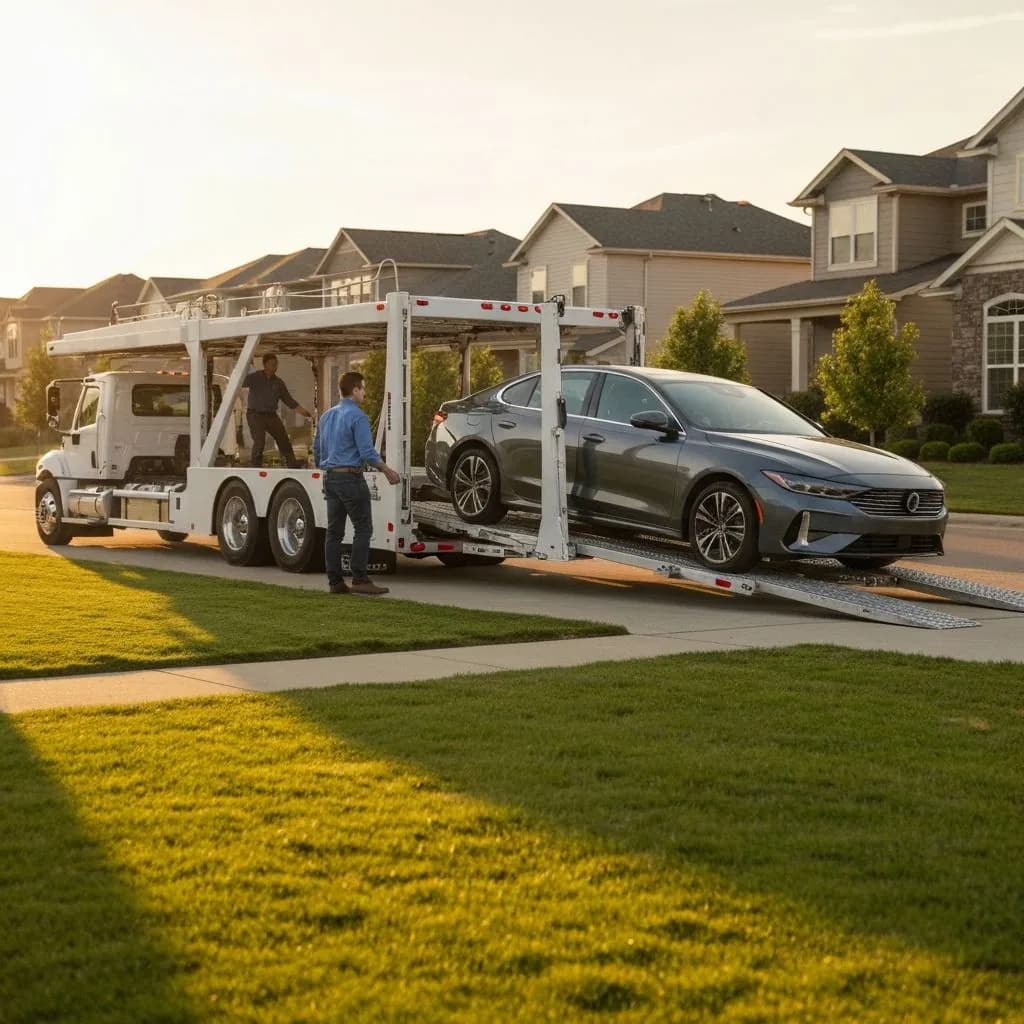
Option 1: Open auto transport (best value). This is what 85% of military families choose. Your car rides on an open multi-car carrier alongside 7-9 other vehicles. It's the same method dealerships use to move inventory across the country. It's safe, insured, and costs $600-$1,400 depending on distance.
Option 2: Enclosed auto transport. If you have a high-value vehicle, classic car, or something you just don't want exposed to road elements, enclosed carriers offer full protection. Expect to pay 40-60% more than open transport. Most military families don't need this unless they're shipping a Mustang GT500 or a restored classic.
Option 3: Drive one, ship one. If you have two POVs (and most dual-military or military-with-spouse families do), the most common approach is to drive one car and ship the other. This is especially practical when one vehicle is packed with items that won't fit in the moving truck — baby gear, gun safes, household items TMO won't touch.
“I PCSed from Bragg to Lewis three times. First time, I drove both cars — took turns with my wife, 48 hours of driving, $800 in gas and hotels. Second time, we shipped one car for $850. The math was obvious. By the third PCS, we didn't even discuss it.”
— SSG (Ret.) Marcus D., Fort Liberty to JBLM
OCONUS: How Government POV Shipping Works
Overseas PCS moves are a different world. The government will ship one POV at no cost to your overseas duty station — but only if the Vehicle Processing Center (VPC) at your port of embarkation accepts it, and only if there's a VPC at your destination.
The government-run POV shipping program is managed by USTRANSCOM through the International Auto Logistics (IAL) contract. Here's how it works:
- 1You get orders. Your PCS orders must specify an overseas duty station that supports POV shipping.
- 2You drop off your car at the VPC. There are VPCs at major ports: Baltimore, Jacksonville, San Diego, Tacoma, and others. You drive your car to the VPC, complete an inspection, and hand it over.
- 3The government ships it by vessel. Your car goes into a container or onto a roll-on/roll-off (RoRo) ship. Transit time to Europe is 3-5 weeks. To Korea or Japan, 4-8 weeks. To Hawaii, 2-3 weeks.
- 4You pick it up at the destination VPC. You'll get a call when it arrives, go to the overseas VPC, inspect it, and drive away.
Here's the catch most people miss: The government ships your car FROM the VPC. It does NOT pay to get your car TO the VPC. If you're stationed at Fort Campbell and you're PCSing to Germany, you need to get your car to the Baltimore VPC — that's about 650 miles. Getting your car to the port is on you.
This is where private auto transport comes in. We ship hundreds of military POVs to port VPCs every year. Fort Campbell to Baltimore VPC runs about $550-$700 on open transport. Fort Hood to Jacksonville VPC is $600-$800. It's a fraction of your DLA and saves you a day or two of driving.
Second vehicle limitations: The government will only ship one POV per service member (or two if you're dual-military with separate orders). If you have a second car, you either sell it, store it, or ship it privately. We work with a lot of military families shipping their second vehicle to a family member's address stateside while their first car goes OCONUS through the government program.
Real Prices for Common Military Routes
Military towns have a lot of auto transport traffic, which is good for you — more carrier availability means competitive pricing. Here are real 2026 prices for the most common PCS routes:
| Route | Open Transport | Enclosed | Transit Time |
|---|---|---|---|
| Fort Liberty (NC) → Fort Cavazos (TX) | $750 – $950 | $1,200 – $1,500 | 5-7 days |
| Fort Drum (NY) → Fort Huachuca (AZ) | $1,000 – $1,250 | $1,600 – $1,900 | 7-10 days |
| Camp Pendleton (CA) → Camp Lejeune (NC) | $1,050 – $1,300 | $1,650 – $2,000 | 7-10 days |
| NAS Jacksonville (FL) → NAS Whidbey (WA) | $1,100 – $1,400 | $1,700 – $2,100 | 8-12 days |
| JBLM (WA) → Fort Stewart (GA) | $1,050 – $1,300 | $1,600 – $2,000 | 7-10 days |
| Fort Campbell (KY) → Baltimore VPC | $550 – $700 | $900 – $1,100 | 3-5 days |
| Fort Hood (TX) → Jacksonville VPC | $600 – $800 | $1,000 – $1,250 | 4-6 days |
| San Diego → any CONUS base | $600 – $1,300 | $1,000 – $2,000 | 3-10 days |
Pro tip: Prices between military installations tend to be 10-15% lower than equivalent civilian routes. Why? Because there's consistent, predictable demand. Carriers know they can fill trucks on routes like Liberty to Cavazos because someone is always PCSing. That volume keeps rates competitive.
The PCS Timeline: When to Book Transport
Timing is everything with a PCS move. Here's when to handle car shipping relative to your orders:
60 days out: Get a quote. As soon as you have orders (or even a good idea of where you're going), get a transport quote. This helps you budget and plan. Prices don't change dramatically in 60 days, but carrier availability does.
30 days out: Book your shipment. This is the sweet spot. Thirty days gives your broker time to find the ideal carrier, and it locks in your price before the PCS-season rush. The June-August PCS window is the busiest time in auto transport. Booking early is the difference between a 3-day pickup and a 10-day wait.
14 days out: Confirm pickup details. Touch base with your transport company, confirm the pickup address (are you shipping from your current quarters, or have you already cleared and moved to a hotel?), and confirm the delivery address at your new duty station.
3-5 days out: Prep the car. Remove your military decals if you're worried about base-specific stickers (most people don't bother). Clean out personal items, ensure the car starts and drives, and reduce fuel to a quarter tank.
June through August is chaos for auto transport. Military PCS moves, family vacations, and college students all compete for carrier space. If you're PCSing in this window, book 45-60 days out instead of 30. We can't stress this enough — we see service members every summer who wait until two weeks before their report date and then can't find a carrier.
Military-Specific Prep Checklist
Military car shipments have a few unique prep requirements beyond the standard checklist:
- Remove base access decals only if shipping from off-base. If the carrier is picking up at your on-base quarters, the decal can stay. If pickup is off-base, it doesn't matter.
- Remove government property. CIF gear, field equipment, anything with a serial number that belongs to Uncle Sam. If it's in the car during transport and something happens, it's a headache for everyone.
- Weapons: Do NOT leave firearms in the vehicle. Full stop. Carriers will not transport vehicles with weapons inside. Secure them separately through your unit arms room or ship them via a licensed FFL.
- Toll transponders: Remove or deactivate your E-ZPass, SunPass, or PikePass. The carrier's truck will trigger them, and you'll get charged for every toll between your bases.
- Parking passes and garage remotes: Remove anything mounted to the windshield or visor that's specific to your current installation.
- Insurance: Confirm your auto insurance will be active during transit AND at your new duty station. USAA and GEICO military policies usually cover this automatically, but verify.
- Spare key: Give the carrier ONE key. Keep a spare with you. If something happens and the car needs to be moved at a terminal, having a backup key prevents a locksmith call.
Military Discounts on Auto Transport
Most reputable auto transport companies offer military discounts. Here's what's realistic and what's marketing fluff:
Realistic discounts: 5-10% off the standard rate. At Scott's, active duty, reserves, Guard, veterans, and DoD civilians all receive a verified military discount. It's applied at booking — no coupon codes, no fine print. You verify your status, and the discount is automatic.
Marketing fluff: "Up to 25% military discount." Any company advertising 25%+ military discounts is either inflating their base rate first (then "discounting" back to normal) or they're a low-ball broker who won't actually get your car picked up. The carrier — the person driving the truck — has to accept the rate. Nobody is eating a 25% cut on a job that already operates on thin margins.
How to verify a real discount: Compare the military-discounted quote to what a civilian would pay on the same route. If the difference is $50-$150, that's a legitimate discount. If it's $400 less, that's a red flag — they either quoted the civilian too high or they're low-balling you and your car will sit.
Other ways to save on military PCS shipping:
- Ship early in the month. Most PCS report dates are the 1st of the month, which means everyone books for late-month pickup. Early-month availability is better and sometimes cheaper.
- Be flexible on pickup window. If you can give the carrier a 3-5 day window instead of demanding a specific date, you'll often get a lower rate.
- Ship both cars together. If you have two POVs going to the same destination, bundle them. Most carriers offer a $100-$200 discount on the second vehicle.
- Use terminal-to-terminal if available. Delivering to a carrier terminal near your new base instead of door-to-door can save $75-$150, though the convenience trade-off rarely makes it worth it.
PCSing? Get Your Military Transport Quote
Verified military discount. Locked-in pricing. We've shipped for every branch, every base.
PCS moves are stressful enough without worrying about your car. Whether you're CONUS or heading overseas, the key is to book early, prep the car properly, and work with a transport company that understands military timelines. Your report date isn't flexible — your carrier shouldn't be either.
Scott's Auto Carrier Team
Written by our team of transport coordinators, dispatchers, and industry specialists. With 20+ years in auto transport, we've shipped over 50,000 vehicles nationwide and know this industry inside and out.