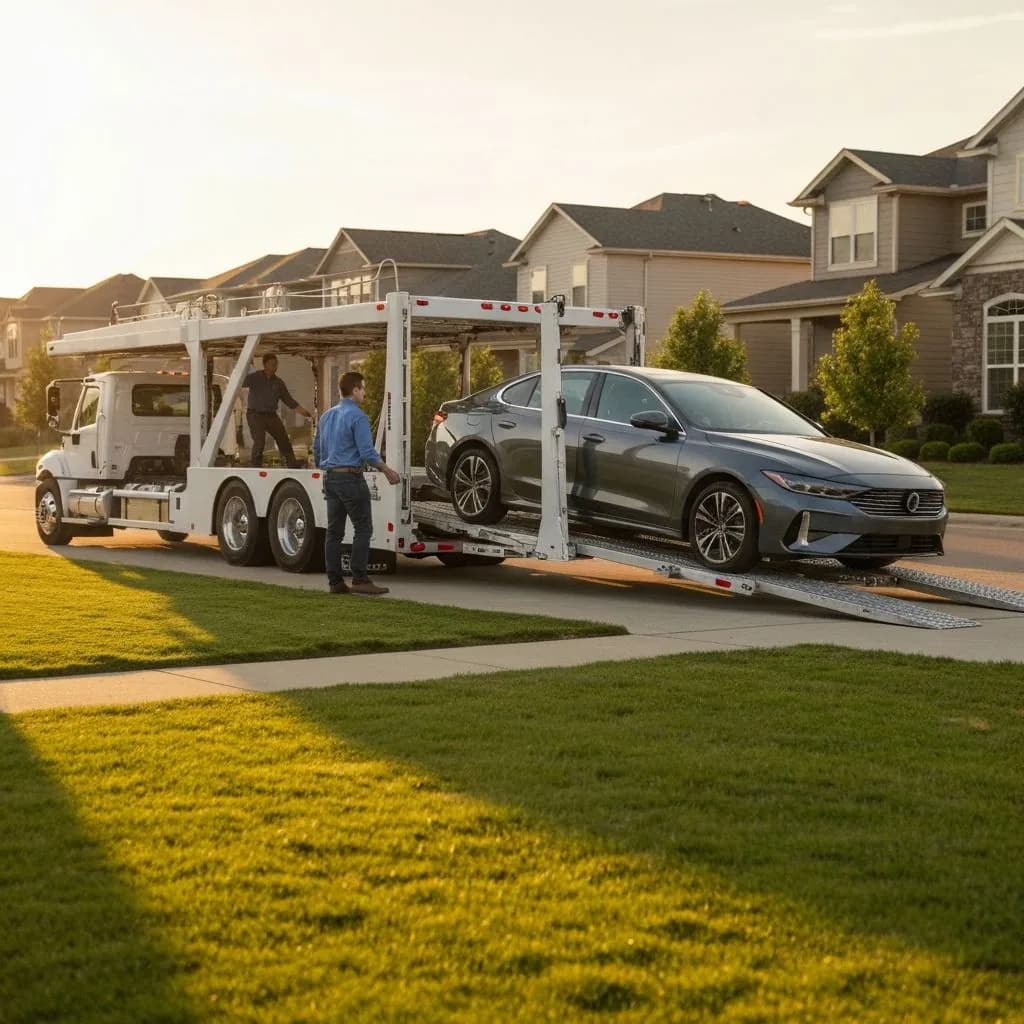
Why EV Transport Is Different
Electric vehicles aren't just cars with a different powertrain. From a transport perspective, they're a fundamentally different animal. They're heavier, they have unique software quirks that can interfere with loading, and their batteries are classified as hazardous materials for certain shipping methods.
A Tesla Model Y weighs about 4,400 lbs — roughly 700 lbs more than a similarly sized Toyota RAV4. A Rivian R1S tips the scales at 7,200 lbs. That extra weight matters because auto carriers have federal weight limits (80,000 lbs gross), which means fewer EVs fit on a single truck.
Then there's the software. Teslas have Sentry Mode, which records video and can trigger alarms when the car is moved. Ford's BlueCruise has parking features that resist being put in neutral. Rivian's gear guard does the same thing. If these systems aren't disabled before loading, the carrier driver has a problem — and your car might not get picked up.
Finally, lithium-ion batteries have specific handling requirements. For domestic ground transport, these are manageable. For international shipping via container or roll-on/roll-off, there are actual IMDG (International Maritime Dangerous Goods) regulations that apply. Even domestically, some carriers simply refuse to haul EVs because they don't want the liability.
How Much Does It Cost to Ship an EV in 2026?
EV shipping costs 10-20% more than shipping a comparable gas-powered vehicle. That's not a markup — it's a reflection of the extra weight consuming more of the carrier's legal payload capacity.
Here's what you can expect to pay for the most popular EV models in 2026:
| Vehicle | Weight | 500 mi (Open) | 1,000 mi (Open) | Coast to Coast (Open) |
|---|---|---|---|---|
| Tesla Model 3 | 3,862 lbs | $650 – $800 | $850 – $1,050 | $1,100 – $1,400 |
| Tesla Model Y | 4,398 lbs | $700 – $850 | $900 – $1,100 | $1,200 – $1,500 |
| Ford Mustang Mach-E | 4,394 lbs | $700 – $850 | $900 – $1,100 | $1,200 – $1,500 |
| Rivian R1T / R1S | 7,148 lbs | $850 – $1,050 | $1,100 – $1,350 | $1,500 – $1,850 |
| BMW iX | 5,272 lbs | $750 – $950 | $1,000 – $1,200 | $1,300 – $1,600 |
| Hyundai Ioniq 5 | 4,225 lbs | $680 – $830 | $880 – $1,080 | $1,150 – $1,450 |
Enclosed transport adds 40-60% to these prices. It's worth considering for high-value EVs like the Porsche Taycan, Lucid Air, or any Tesla with FSD — the software package alone can be worth $8,000-$15,000 and is tied to the VIN.
Carriers can typically fit 8-10 sedans on a standard car hauler. Because EVs are heavier, they might only be able to carry 6-7 before hitting the 80,000 lb federal weight limit. Fewer cars per load = higher price per car. It's basic math, not a surcharge.
The Battery Charge Rule: 30-50% Is the Sweet Spot
Every reputable carrier will tell you the same thing: charge your EV to 30-50% before pickup. Not 100%. Not 10%. Here's why both extremes cause problems.
Too high (above 80%): Lithium-ion batteries at high state of charge are more susceptible to thermal events. While the risk is extremely low, carriers are trained to minimize it. More practically, a full battery adds unnecessary weight — on a Tesla Model Y, the difference between 20% and 100% charge is negligible in weight, but the safety protocols change.
Too low (below 15%): The car needs enough charge to be driven on and off the trailer. That's typically 3-5 miles of range minimum. But here's what people miss — the car also needs charge for accessory power during transit. Security systems, 12V battery maintenance, and telematics modules all draw power. A car that arrives at 0% SOC might not even turn on for delivery.
The 30-50% range gives the carrier enough power to load/unload, keeps the battery in its safest temperature zone, and ensures the car arrives with enough charge to drive home from the drop-off point. Every EV we ship at Scott's is verified at pickup to be within this range.
“We had a customer ship a Rivian R1S at 4% battery. It died on the trailer in transit. The driver couldn't move it off the truck at delivery. Had to call a flatbed to winch it off. Added $350 and two days to the delivery. Charge your EV before pickup.”
— Scott's dispatch coordinator
EV Prep Checklist: What to Do Before Pickup
Preparing an EV for transport takes 15 minutes. Skipping these steps can delay your pickup by days. Here's the full checklist:
- 1Charge to 30-50% SOC. Check your app the morning of pickup. If you're above 50%, run the climate for a bit.
- 2Disable Sentry Mode (Tesla). Go to Controls > Safety > Sentry Mode > Off. If Sentry is active, the car will alarm when the carrier loads it and may record the driver (which some drivers refuse).
- 3Disable Gear Guard (Rivian). Rivian's equivalent of Sentry. Turn it off in the security settings.
- 4Turn off BlueCruise / parking features (Ford). Mach-E's automated parking can resist being put in neutral on an incline — which is exactly what a car hauler ramp is.
- 5Put the car in Transport Mode if available. Tesla has this under Service > Transport Mode. It disables the parking brake and air suspension adjustments. Other EVs may have a similar setting.
- 6Fold the mirrors. Most EV side mirrors are wider than ICE equivalents. Folding them prevents trailer contact.
- 7Remove the charge cable from the frunk/trunk. Mobile chargers can shift during transport and scratch interior panels. Take it with you.
- 8Lower the air suspension (if equipped). Teslas, Rivians, and Mercedes EQS models with air suspension should be set to the lowest ride height. This lowers the center of gravity and makes loading safer.
- 9Retract the door handles (if applicable). Some Teslas and the Model S have auto-presenting handles. Set them to not auto-present.
- 10Note any existing damage and take photos. This applies to every car, but EV paint (especially Tesla's) is notoriously thin. Document everything.
Open vs. Enclosed for EVs: Which Should You Choose?
For 90% of EV shipments, open transport is perfectly fine. Your Tesla Model 3 doesn't need an enclosed trailer any more than a Honda Accord does. Open carriers are fully insured, your car is strapped and secured, and the risk of road-debris damage is about the same as driving the car yourself on the highway.
Choose enclosed if:
- Your EV is worth over $80,000 (Porsche Taycan, Lucid Air, Tesla Model S Plaid)
- It's a limited edition or has a custom wrap you want to protect
- You're shipping in winter through salt-belt states and want zero exposure
- The vehicle is brand new with delivery miles only — any scratch will bother you
- It's a Cybertruck (the stainless steel shows every water spot and fingerprint)
Enclosed transport for EVs runs 40-60% more than open. On a coast-to-coast Tesla Model Y shipment, that's roughly $1,800-$2,200 enclosed vs. $1,200-$1,500 open. The enclosed carrier also typically holds only 2-6 vehicles vs. 8-10 on an open carrier, so scheduling takes a bit longer — plan an extra 2-4 days.
2026 EV Transport Regulations: What's Changed
The auto transport industry is catching up to the EV revolution. Here's what changed in 2025-2026 that affects your shipment:
FMCSA weight exemptions. The Federal Motor Carrier Safety Administration extended a pilot program allowing carriers hauling EVs an additional 2,000 lbs over the standard 80,000 lb GVW limit on Interstate highways. This means carriers can fit more EVs per load, which should gradually bring prices down.
Updated carrier insurance requirements. Several major insurance underwriters now require carriers to document battery SOC at pickup and delivery if transporting more than two EVs on a single load. This is good for you — it creates an official record of your car's battery state.
State-level EV transport permits. California, New York, and Washington now require carriers to hold a supplemental EV endorsement if hauling five or more electric vehicles. This is mostly a paperwork item for the carrier, but it weeds out inexperienced operators.
Battery incident protocols. DOT updated the Emergency Response Guidebook (ERG) with specific procedures for lithium-ion battery incidents during vehicle transport. Every carrier in our network is required to carry the updated ERG and have at least one driver trained on EV battery emergency procedures.
How to Choose an EV-Experienced Carrier
Not every auto transport company has experience with EVs. And the ones that don't can cost you time, money, and scratched paint. Here's how to vet a transport company for EV experience:
- 1Ask how many EVs they've shipped in the last 90 days. Any legitimate EV-experienced carrier has shipped dozens. If they hesitate or say "a few," move on.
- 2Ask about their battery SOC policy. If they don't mention the 30-50% rule unprompted, they don't have one — which means their drivers are winging it.
- 3Ask about their weight policy. A good carrier knows that heavy EVs affect their load capacity and prices accordingly. A bad one quotes you a sedan rate for a 7,200 lb Rivian and then either bumps your car or demands more money at pickup.
- 4Ask about Sentry Mode / security system protocols. An experienced carrier will remind you to disable these before pickup. An inexperienced one will show up and call you in a panic because the car is alarming on the trailer.
- 5Check their cargo insurance limit. You want at minimum $250K per vehicle in cargo coverage. For high-value EVs, $500K+ is better. Ask for a certificate of insurance, not just a number.
- 6Ask if their drivers have EV loading training. Loading an EV in Transport Mode is different from loading a regular car. The regenerative braking behaves differently, the steering lock is different, and the gear selector varies by manufacturer.
We've shipped over 4,000 EVs in the last 12 months — Teslas, Rivians, Lucids, Porsches, BMWs, and everything in between. Every carrier in our network is vetted for EV experience. We verify battery SOC at pickup, and our price is locked the moment you book. No surprises.
Shipping an EV? Get Your Locked-In Price
EV-experienced carriers. Battery SOC verification at pickup. Prices locked at booking.
Scott's Auto Carrier Team
Written by our team of transport coordinators, dispatchers, and industry specialists. With 20+ years in auto transport, we've shipped over 50,000 vehicles nationwide and know this industry inside and out.